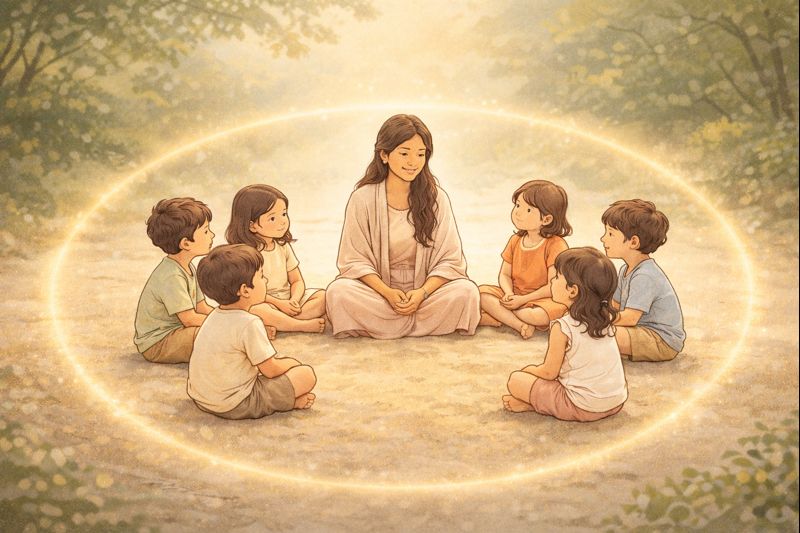
Aekyaṃ is a space that brings together wisdom from Bhāratīya (Indian) Knowledge Systems, the needs of young learners, and the role of teachers as facilitators—creating learning spaces where children grow through connection, curiosity, and care.
The four major pillars of Aekyaṃ are Bhāratīya Knowledge System, Foundational learners, Teachers as facilitators, and Learning through relationships.
- Bhāratīya Knowledge System : Aekyaṃ draws from hymns, stories, metaphors, practices, and worldviews within the Bhāratīya Knowledge System to introduce ideas of unity and interdependence between the individual and the world in ways that are simple, joyful, and meaningful for children.
- Foundational Learning : Learning experiences are carefully designed for young children—through images, drawings, picture cards, and other visual prompts, as well as activities, play, and stories—respecting their pace, curiosity, and ways of making sense of the world.
- Teachers as Facilitators: In Aekyaṃ, teachers act as facilitators in the classroom, observing, guiding, dialoging, encouraging questioning, and supporting children in discovering connections on their own.
- Learning as relationships: Aekyaṃ believes learning is a net of relationships—between the individual and the world, community, culture, and self—nurturing balance, care, and shared responsibility.
Learning becomes meaningful when it is rooted, reflected and realised.
 Aekyaṃ